"Swimming in the Watershed "
Pleasant Lake NH // Railway River NH
Date of Excursion: September 26th, 2017
On September 26th, it was an extremely hot and sunny day, we were all sweating bullets on the bus and just standing out in the sun, so we took advantage of the opportunity we got to get into the cool lake and river, while at the same time learning a lot about the bodies of water we were visiting and collected data to compare the two. We studied both the quality of the water and and the creatures that were living there, of which we found quite a few. We unfortunately did not have time to get to our third location.
We left school at 2:05pm sharp on a scorching hot bus to make a 10-15 minute drive to Pleasant Lake in Merrimack County, New Hampshire. Pleasant lake is a 602-acre lake/watershed, which is defined as "an area of ridge of land that separated waters flowing to different rivers, basins or seas". Basically, Pleasant Lake collected water which flowed down from the hills down the slightly inclined banks, and the water from this watershed would flow east to the Blackwater River (tributary of the Contoocook River), then to the Merrimack river and ultimately end up in the sea.

photo by nelsap.org
Here, we took a look at a map and looked at how to read elevation with the thinner and thicker lines, and we looked at the rivers flowing everywhere that looked almost like veins. We went over again "Biomes", "Biospheres", "Community", "Population" and talked about "ecology" (the study of all living and nonliving things in an ecosystem), learned the acronym "ABCDEE" (abiotic, biotic, cycle, diversity, energy, evolution). The quantitative data we collected from this location (and later, the other one as well) included the water temperature, air temperature, Ph, turbidity, and phosphate levels. We also collected some qualitative data such as the weather and location. All the data we collected can be seen in the table below.

As an open body of water with few trees around it, the temperature of the water and the air were quite high. The water was refreshing but still quite warm. The air temperature was so high that we were sweating from just standing out there. It was sunny and the skies were clear, with not many clouds at all. Here we learned to collect the data, using a thermometer. I found the turbidity measuring the most interesting, because it was something I had never heard of or seen before. It is defined as "Turbidity is the cloudiness or haziness of a fluid caused by large numbers of individual particles that are generally invisible to the naked eye, similar to smoke in air. The measurement of turbidity is a key test of water quality." it's measured in JTU, and its measured by collected a measuring cylinder full of water and then it's held over a plastic sheet of paper, then you use your eyes and compare how clear it is to the colors on the side. The images of the turbidity measurements are below.


photo by Anna Krajewski (Pleasant Lake) Photo by Peppy Pettengill (Railway River)
After a refreshing dip in the lake, we hopped back into the bus and drove downstream to the Railway River that runs down Proctor property. The first thing I noticed here was that the water wasn't quite as calm and still as Pleasant Lake. At this location, the water was much shallower and there were a lot more bugs around. With that, though, we were also able to find more living organisms in the water, like the stonefly. This river was much more shaded and covered by trees, so both the air temperature and the water temperature were much lower. The water felt a bit muckier and dirtier, but the tests proved otherwise. The quality of the water, however, was quite similar to that of pleasant lakes (as seen in the table above). Alan said that he could find "one stone fly on every single rock [he] picked up". This meant that stoneflies were very abundant and there was a large population density of them in the area. He also said that "just because we find more creatures in the water here, it doesn't mean there are more creatures here than in pleasant lake. It's all dependent on the area that we're in. We only covered a few meters of area in each body of water.". We pretty much underwent the same process of data collection at this location. Unfortunately, we couldn't stay long, because we had to drive back to school to get to our afternoon activities.

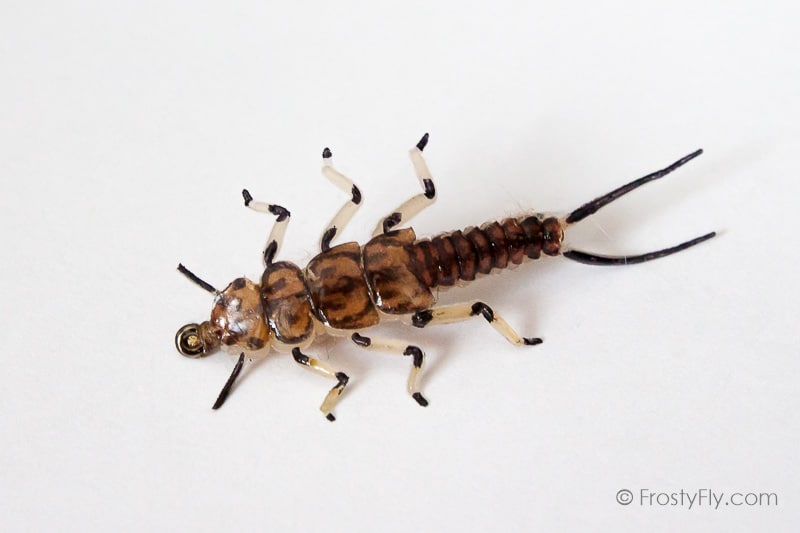
photo by frostfly.com (stone fly)

photo by Lauren Ho (railway river)
photo by Anna Krajewski (rocks the stoneflies were on)
I was really happy that I got this experience. It was my first field trip as a Proctor student! I felt that going out and doing hands on work really helped me learn a lot about the environment around us. I was especially excited about getting the chance to use the different, cool but simple, tools to measure the different aspects that make up the quality of water (thermometer, turbidity, pH etc.). At the same time, not only did I learn about the bodies of water, I also learned about New Hampshire. I followed where we were on the map and I was able to figure out our bearings (not literally!) and see how everything was connected, and where we and the bodies of water were relative to everything else. I was fascinated by the life forms that we found in the lake and the river. It was the first time I had ever seen a stone fly, and we also got to see some fish and a frog that hopped away very quickly on the bank at the railway river. Personally, I wish we could've stayed longer and visited more locations, partially because it was lots of fun, but also to collect more data to compare more different bodies of water in the same region, several of which would be connected. It's unfortunate we had such strict time restrictions. If there was a next time, I'd also try to get into the water, because it was difficult to do this time around for a number of reasons.

No comments:
Post a Comment